Last year I got a letter from a wooden spoon collector named Norman D. Stevens of Storrs, Connecticut. It seems that he became interested in collecting spoons by American woodcarvers. One of his internet searches pulled up my name and he sent a letter inviting me to contribute to his growing collection which I did.
The more I thought about this, the more I appreciated what Norman is doing. He is documenting the state of wooden spoon making throughout the world in the early 21st century. Norman has complied a directory of perhaps as many spoon makers he has identified, and is maintaining hard copy files with background information and correspondence with many of those artisans.
More importantly, he is creating a catalog describing each contributor to his collection and his or her spoon. A number of his spoons are on display through May 23, 2010 in an exhibit at the American Association of Woodturners in Saint Paul, MN.
Norman Stevens Spoon Collection Display
There will also be a special display of many of his spoons, with presentations by Norman, at the AAW Symposium in Hartford, CT from June 19-20, 2010. That exhibit is open to the public without charge. Further information can be found at: http://www.woodturner.org/sym/sym2010/. AAW will be issuing and selling a catalog for the exhibit at the Symposium that will contain color images of about 100 of the spoons. There is also an exhibit scheduled for the Gallery-on-the-Plaza of the Homer Babbidge Library of the University of Connecticut. If you are interested in his project his e-mail is: normanstevens@mac.com.
What a nice thing to do! Spoon makers are not exactly in the spotlight of American woodworking so to pay tribute to the many fine craftsmen who devote their energies to spoon making is like a breath of fresh air to me.
Spoons Got Me Started in Woodworking
It turns out that wooden spoons were my first venture into woodworking as an adult. I had cut down a maple in my back yard to make some light for a vegetable and rose garden. The wood was so pretty and white that I couldn’t bear to split it all for firewood so I saved a log or two.
By the time I got around to a project with the maple it had spalted nicely. My first impression was that the wood was ruined but the more I worked with it the more I came to appreciate the spalting. As I learned more, I realized that I had cut a curly maple log that had spalted and then I wished that I had saved the whole tree.
There are as many ways to make a wooden spoon as there are wooden spoon makers. I thought I would just share some of my thoughts about the craft. A test I once took indicated that I was a pragmatic idealist. That sounds like a bit of an oxymoron but it really does describe two opposite aspects of my character.
Spoons For Looking And Spoons For Cooking
I do appreciate the intricate work of spoons with all of the delicate cut out work, but the spoons I wanted to make were to be used in cooking. Every fine cook knows that nothing beats a good wooden spoon. So my spoons had to be practical and built to last.
My first ones were a bit clunky but seemed to please the intended users. On the other hand, I wanted my spoons to reflect the beauty of nature stored in the wood and that this be set off by some refinement of the design.
One thing I looked for in the design was a sturdy handle. The flimsy ones from the box stores are too easy to break. I wanted ones that would hold up to the hardest tasks. I got an e-mail from one of my customers this year. She said the spoon I made for her was the only one that was up to stirring her fruit cake batter and it was her favorite spoon. That appealed to the pragmatism in my nature.
Taking Advantage of Wood Grain
As I learned more about woodworking I realized that making the handle parallel to the direction of the grain made for a handle which was stronger and not quite as much mass was needed to keep the handle sturdy.
With more experience I learned that the grain does not always run straight in every piece of wood and that it was alright to have the handle curve this way or that following the grain of that particular log. In the colonial days the wood for spoons was rived with a froe (a metal blade which was pounded into the end grain). This caused the wood to split right along the path of the grain and all handles produced in this manner had handles which followed the grain.
Some still rive the wood for spoons and this is a fine way to make them. Yet I need to do production work as I sell many spoons at craft shows. They are one of the most consistent sellers. I have probably made more than a thousand spoons and so now I cut my blanks from wood which has been sawn into planks with the band saw. The band saw is such a useful tool as it allows you to make planks out of any log or branch that comes your way.
Below is a picture of a few of my spoon blanks.
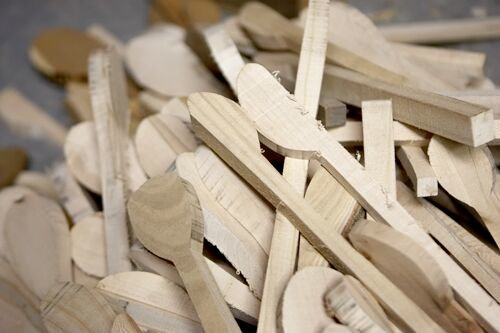
Another thing I learned is that cooks like spoons that are not completely symmetrical and they like odd shapes. It may help them locate their favorite from their collection and the odd shape or curved handle may be just what is needed for a particular job.
So now I vary my design to suit the wood grain and my whim and just draw the design freehand on the plank. This way it is easy to follow the grain in the handle. I then go back to the band saw and cut the outline drawn on the plank.
Gouging the Spoon’s Bowl
The next challenge is to hollow out the bowl of the spoon. Again, the ways to accomplish this task are numerous. I settled on using a spoon gouge with a curvature that suits the maker. Too shallow and the edges of the gouge will dig into the sides of the spoon bowl… Too steep and you will get deep grooves in the wood and not a smooth flowing curve of the spoon bowl.
The width of the gouge is also a matter of personal choice but I use one wide enough to remove plenty of waste wood with a single pass. I have had a number of bent gouges but they seem to have a propensity to wander off when I do demonstrations and the only one left is one that never leaves my shop. It is a firmer gouge, meaning that it is thicker and will stand up to repeated heavy use. It is the one in use in the picture below.

Now unless you are a whole lot stronger than I, you will not be able to push this gouge through the wood for very long using just the muscles of your hands and arms. This is especially true of hard woods such as fruit woods like cherry and apple.
To remove large amounts of wood quickly I use a wood carver’s mallet. The one shown above I made of a dogwood head (very hard) and a hickory handle. Beech also works well.
Notice that the handle of the gouge has a metal ferrule on the end which keeps the wood of the gouge handle from splintering from repeated blows. With these tools I am able to remove large amounts of waste wood quickly. I keep the spoon blank secured to the work bench with a simple clamp.
I start at one end of the bowl and remove some wood. However, if I go too deeply the wood will tend to split and ruin the blank. So I go as far as I dare and then remove stock from the opposite side. I always work in the direction of the grain. By going back and forth from one end to the other I can remove large amounts of waste in a short period of time.
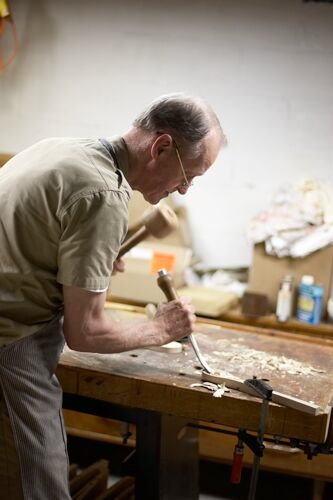
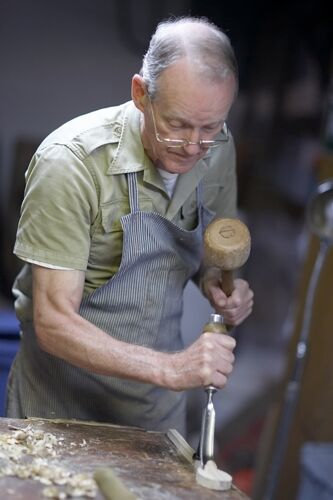
By angling the cutting edge of the gouge one way or the other you can begin to shape the walls of the spoon bowl. The straight cuts work best for roughing out and for the bottom of the spoon. Below I am cocking the gouge to one side to make the near wall of the spoon bowl.
Here you need to exercise care not to take such big cuts as will cause splitting because you are now working on a thin rim of the spoon with less margin for error. You will find that some species of wood will split far more easily than others.
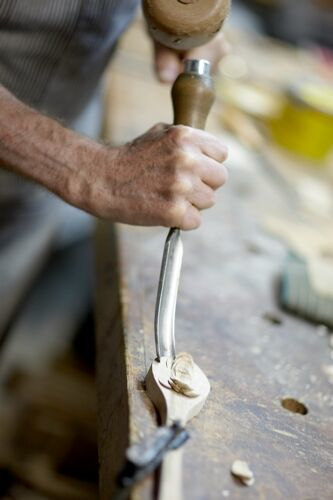
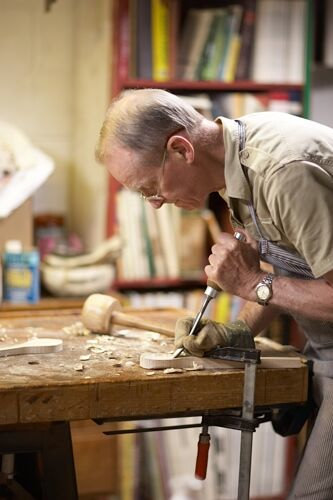
You can only get so much control of the cutting edge of the gouge when you are pounding on it with a heavy carver’s mallet. So for finer cuts I just use muscle power without the mallet striking the gouge as seen in the picture below. Notice I use a glove on the hand that guides the cutting edge.
Considerable force is needed to make even these lighter cuts and if the hand slips it may hit sharp corners of the band sawn edge of the blank and cause cuts. Using a glove in the hand that does not grip the gouge handle cuts down on the need for band aids and loud exclamations.
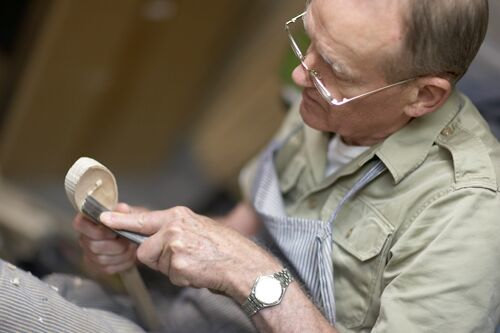
For the finest cuts I remove the blank from the clamp on the bench, sit comfortably and use the gouge free-hand as you see me doing below. This gives maximum control and allows clean up of any rough areas left from previous steps.

In my earlier spoon making days I used to carve the outside of the bowl of the spoon and the handle all by hand. I used a combination of gouges, draw knives and small pattern maker spoke shaves to remove the waste. However this is a slow process.
Now I use a large belt sander with an aggressive planer belt from Klingspor. With a bit of practice you can smooth the contours and remove all the bandsaw blade saw marks. You can even round out the handle.
Sanding and Oiling the Spoons
What remains is to hand sand the spoon. I do not go above 220 grit as these spoons are for cooking and finer finishes are not important. I oil my spoons with sesame oil. I used to use mineral oil but since this is a petroleum based product and not renewable, I feel more comfortable using a vegetable oil.
I choose sesame oil as it has the longest shelf life of all the non-drying oils and does not become rancid easily. This is due to unique antioxidants found in sesame oil and not in other vegetable oils.
I don’t recommend olive oil as it spoils very quickly and you get a tacky residue building up on the utensil. A food safe drying oil such as tung oil can also be used.
Care of the finished product is very easy. Just wash in soapy water and let it air dry. Over the course of time the surface may become whitened due to fragmentation of the fibers with repeated use and washings. Just apply another coat of sesame oil and the finish is restored.
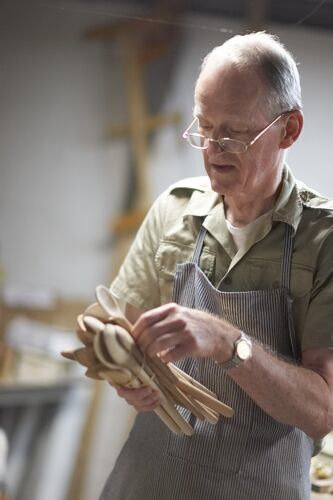
For heavily used spoons a light sanding before reapplication of the oil is all that is needed. A well cared for spoon can last for generations. Below is a picture of spoons ready for oiling.
Other Methods of Wooden Spoonmaking
I would just like to say a few words about other methods of making spoons. If you only want to make one or a few, then you may enjoy carving them completely by hand. This allows for great individual expression.
There are even special tools for hollowing out the bowl such as curved bladed carving knives or special spoke shave like tools with a curved blade. Just bear in mind that the curve of the spoke shave tool will limit the radius of the bowl of the spoon.
More recently I have used special carbide cutting burrs with a flexible shaft tool. There are burrs which are suited to hollowing the bowl of the spoon. There is a bit of a learning curve to this. It requires a firm hand and practice to know how aggressively to make the cuts or you will find that the bit wanders and wipes out the rim of the spoon you are trying to make.
It is easier with one of these tools to make a deeper bowl in a spoon than you can with spoon bent gouges. After using the burrs I clean up the tool marks with the hand held spoon bent gouge using light finishing cuts. So for certain shapes I have actually come to prefer this method of hollowing.
Some spoon makers turn a blank on the lathe. This gives a very symmetrical round handle and outside of the bowl of the spoon. Then they may use a saw to remove waste from the spoon bowl and use some hollowing process to carve the inside of the spoon bowl.
Some even mount this on the lathe and turn it out. Be advised that what you have is a spinning propeller and take care to keep fingers away from the spinning handle which you cannot completely see.
So, I have not tried to provide a comprehensive treatise on spoon carving but rather to share with you what works for me with an eye towards making useful and practical cooking spoons in sufficient quantity to meet the needs of my crafting.
I find that it is a good means of using up odds and ends of wood from the shop. After more demanding tasks I find it very relaxing to work up a few spoons and allow for my creativity to express itself in this simple way.
Wooden spoons make wonderful gifts. People especially love when the wood is from a tree or a limb that they gave you. With a bandsaw, any limb wood can produce good spoon blanks. It provides them with a connection to the nature that they had known and come to love. The tree may be gone but the memory of it survives in the spoon and that can be passed down from generation to generation.
I found your website very informative and your level of expertise is astonishing. Artisans give a special touch to our houses, and the spoons you make are way more appealing than the ones sold in stores. You are truly an example to follow.
Dear Jose:
Thank you for your kind words. I feel that the tools we use everyday should be beautiful as well as functional. Nature supplies the beauty in the wood and my simple designs supply the functionality.
Edwards Smith
I truly love your blog.. Great colors & theme.
Did you develop this amazing site yourself?
Please reply back as I’m trying to create my own website and want to learn where you got this from or just what the theme is named. Many thanks!
I’m truly enjoying the design and layout of your website. It’s a very easy on the eyes
which makes it much more enjoyable for me to come here and visit more often.
Did you hire out a designer to create your theme? Exceptional work!
Dear Las Vegas and Normand:
The web site was designed by my son but the theme is my own. Thank you for your nice remarks.
Edwards Smith
As a beginner I love to see your kind of tutorial….I really don’t know what I ‘m doing yet but you gave me ideas to start carving spoons which I ‘ve wanted to do for awhile…thanks!!!!
We all start from where we are. I was just a beginner when I started. What is great about the internet is
that we can share our knowledge with so many people so that our progress can be so much more rapid. It is said that
well begun is half done. The first step is the hardest. The more you do the easier it gets. So just plunge in
and it will get easier and easier.
Edwards Smith
hi!,I like your writing very much! proportion we
be in contact more about your post on AOL?
I need a specialist on this house to solve my problem.
May be that is you! Looking forward to peer you.
Hi Edward,
Thank you so much for sharing your experience and work. I was just wondering if you could tell me what size the gouges are that you use for carving the bowl on you wooden spoons? They are bent gouges correct? And what brand are they? I live in Winnipeg, Canada and have started making spoons to sell at markets and craft sales.
Thanks
Carson
Dear Carson:
Thank you for your comment. I use a bent gouge with an approximately 20 mm wide sweep. Good gouges are available from Woodcraft Supply , Woodcarvers Supply and other stores catering to woodcarvers and furniture makers. The Swiss Made tools have a very nice finish but my first ones were Henry Taylor tools and they have served me well.
I have also been using a Mastercarver from Wood Carvers Supply. It is a flexible shaft power tool. I use a large carbide burr made for spoon makers to hollow out the inside of the spoon bowl. I find that I can do more spoons in less time with less stress to my hands. The same tool can take a flap sanding wheel (2 inch) from Klingspor which will clean up the scratches in the spoon bowl very quickly. When you do spoons to sell you have to strive to become more efficient. I also use a belt sander to shape the outside of the spoon bowl and to round the handle. After that there is very little hand trimming left to be done. As you progress and begin to sell your wares you might want to consider adding these power tools.
Just get started and you will learn as you go. A wood worker is always adding refinements to what he does.
Sincerely,
Edwards Smith
I live in an urban environment without ready access to trees that I can cut branches off. How may I obtain the wood needed to carve spoons?
Dear Mary:
Trees grow in cities. They are always coming down in storms or due to construction. Cities usually have a lot where this “waste” wood is dumped. Usually wood there is free for the taking. When driving out of town you may see wood that has been cut to trim right of ways for utility lines. It usually is free for the taking. Another source is to make friends with a tree cutting service. They may be happy to trade some branches for finished products. All that wood just goes to make wood chips anyway. When all else fails you can salvage scrap wood from demolition projects or go to a lumber yard and see if they have scraps from wood that has been cut to dimension lumber.
If all this is beyond your capability I could sell you some pre-cut spoon blanks for a reasonable price. These would be sawn to a rough shape on the band saw and you could carve out the bowl and round out the handle with
simple hand tools. They could be of any shape or size depending on your desires. You see me working on such blanks in the blog post on spoons.
Sincerely,
Edwards Smith
Mr. Edwards,
I am completely new to your wondeful site. The second I stumbled across it I seen the immense value it will hold.
Your mention of all woods being possible to use I was wondering if any will leak sap or oils that would leave toxic or bad tasting residues, and if soft woods are too soft to use period. I have abundant cedar which I think would make beautiful spoons due to the color of the wood. I just don’t know if it is safe to use.
I am interested in trying spoonmaking because there are none that are commercially available that hold up. Being a chef I like the sturdy utensils that won’t mar or scrap the interior of cookware.
Thanks for your reply.
Sincerely,
Frank
I work at the renaissance faire and decided that I wanted to carry a spoon and eating spike this year, and since I’ve been doing wood working with my dad since I was little I wanted to make them myself but had no clue where to start. Thanks to this I know where to start. Thanks so much!
I’m thinking of making some cooking spoons and thought your article was very informative. Especially the use of vegetable oils. However, I wish you would address which woods are easy to work with yet are durable for heavy use in the kitchen. It worries me that as a novice, I might pull out the wrong type of wood from one of the wood sources you mentioned. Also, are all woods food safe or are there some exotics that we should stay away from.
Hello Edwards,
I see you carve the spoons by hand. Have you also created some on the lathe? I realize you cannot finish a spoon on the lathe but much of the work could be done there.
Regards,
Brian
Mr. Smith, I found your website very informative. We had to cut down not 1 but 2 maple trees today. they literally died overnight this past fall. the bases turned black for some unknown reason. I am left with several 6 ft. logs and many many limbs several inches in diameter. My husband plans to make 2 bows for my sons…of course I told him he couldn’t leave out his daughter so maybe 3 total. I googled wooden spoons and voila there you are. I plan to attempt this with my wood. We live on a sustainable grass fed beef farm in rural SC, so this fits. I had purchased a really nice hand carved wooden spoon from the farmers market this fall and wanted more. Now, Iwill try my hav=nd at it. Any suggestions for a beginner? Are there classes offered on this craft? Thank you! Happy Carving!!!
Hello. I am looking for a Connecticut artisan who can make a wooden bowl for me out of a piece of a tree that came down in my yard which has a giant knot. Can you point me in the right direction? Thanks, Pam
Hello,
Thoroughly enjoyed your article
Why do you not drill a starter hole in the spoon bowl ?
Thank you so much for this information. I took a one day spoon carving tutorial and really enjoyed it, your webpage has spurred me on to continue.
Happy carving!!
I recently cut down quite a few trees from my yard and I would like to utilize the wood to make some wood utensils such as spoon. My question is given that there could be bugs in the tree so how should I treat the trunk/branch before I start making the spoon? Maybe I should ask do I need to treat the nature wood? Thanks. Daphne