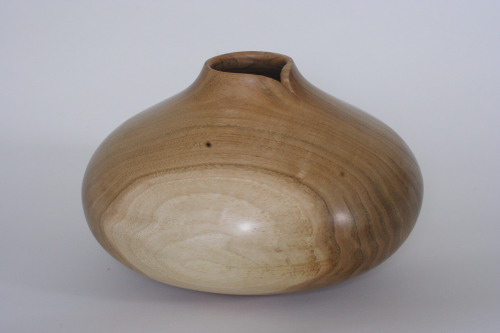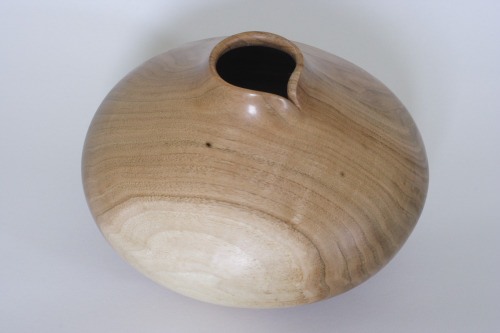
Norway Maple Hollow Form
This hollow form vessel is 11 x 5 inches and is made from an old Norway maple which had died. I got a notice from our local woodturning club that one of the members had rescued some of this tree from becoming firewood and asked if anyone had any interest in it. So on a very rainy November day I met with two of our club members to see what the story was.
The tree had been planted by the property owner and was at least sixty years old or possibly older. It had died and he had the tree felled and cut most of it up for firewood. This is when our club member discovered that a big crotch section which is very difficult to split and a couple of feet of the stump remained.
One man had brought an electric chain saw and the other had no saw. Fortunately I have a Stihl 440 and made quick work of sawing up the crotch and the stump wood into manageable chunks of wood.
Towards the end of the afternoon it began to rain really hard. So we quickly divided up the wood and I headed home for a hot bath and some dry clothes.
What is Norway Maple?
I really did not know much about Norway maple. It is native to northern Europe and, of course, Norway. It has been planted as an ornamental in the US for many years. Some have expressed concern that it may become an invasive species displacing the habitat of our native American maples.
It is still rare in my experience as this was the first of its kind I had knowingly experienced. My reading indicated that some scholars feel that the Stradivarius violins and cellos were made of Norway maple.
Whether this is the case or not when you get into crotch pieces or near the base of the stump of most any tree you will get highly figured wood due to the wood fibers undulating rather than growing as straight rods.
This gives the optical illusion of light and dark bands. This is caused by interference patterns of light being reflected at different angles from the surface. If you shift the wood the bands may seem to move a bit so you know it is an optical effect.
Whatever the cause, the visual effect is stunning. It has been called chatoyance because of its similarity to the optical effect of the semi-precious stone, cat's eye that seems to shift as the stone is moved.
Also in the split wood pile we rescued some pieces of burl which I use for making scarf pins. The rich chocolate color and swirled pattern is most attractive.
How to do Hollow Form Turning
The technique for making the hollow vessel is to mount the block of wood on a face plate and then turn the outside dimensions except for the foot. Then a special boring tool is used to make a small opening in the vessel and a similar but angled boring tool is used to slowly cut away inside wood up to the final thickness of the vessel.
You have to stop the lathe many times to check on the final thickness of the vessel wall. When that operation is complete then the vessel is reversed and held by a jam chuck on the headstock end and the center of the tail stock. With the bowl mounted on the lathe in this way, wood can be carefully removed from the outside base of the bowl to finish the design.
Wood which is turned green like this is much softer and the turning process requires less energy and goes faster. Since the wood is very thin I don't seem to get major warping and it only takes a few days to dry before applying the final finish.
So, this old Norway gets a second life as a hollow vessel. Who knows, it might live longer in the art piece than the tree lived in that man's yard. The idea of extending the usefulness of a tree which has died appeals to my conservative nature.
It took so long to create that beautiful wood that it just seems proper to extend and expand that beauty for more people to see and wonder at the infinite creativity of Nature.